
Two doctors in white coats walking and talking in a modern hospital lobby with glass walls.

Fire and life safety services for healthcare facilities


PRECISION SAFETY FOR THOSE WHO CANNOT WAIT
Protecting healthcare's life-sustaining mission.
Your mission is uptime – our mission is protecting yours.
No downtime. No data loss. No second chances.
CONTACT FORTIS
In a hospital or long-term care facility, a false alarm isn't just a nuisance — it's a clinical disruption. That's why we bring surgical precision to our inspections and repairs, navigating the complex web of standards so you don't have to. Hallways. Patient rooms. Surgical suites. Meticulously protected by systems that work without fail. All day. Every day. You carry the weight of protecting those who cannot protect themselves. We lighten the load. Fortis strips away the stress of high-stakes compliance, replacing it with confidence. Let your staff focus on the patient, not the floor plan.
Close-up of a red fire sprinkler head mounted on a ceiling pipe.
What fire and life safety requirements apply to healthcare facilities?

Healthcare facilities — including hospitals, surgery centers, medical office buildings, and long-term care facilities — are subject to some of the most stringent fire and life safety requirements of any occupancy type.

Primary standards include NFPA 99 (Health Care Facilities Code), NFPA 101 (Life Safety Code), and CMS Conditions of Participation for Medicare and Medicaid-certified facilities. These standards govern everything from sprinkler system design and fire alarm configuration to smoke compartmentation, fire door maintenance, and defend-in-place evacuation protocols.

Facilities must also satisfy state health department licensure requirements and, where applicable, The Joint Commission accreditation standards — all of which require documented, ongoing inspection and maintenance programs.

Contact Fortis

WHO manages fire protection for healthcare facilities

You Protect the People Who Protect Everyone Else.
Fire and life safety in healthcare touches facility operations, clinical leadership, compliance, and long-term care — each role carrying its own set of obligations, and each one depending on systems that cannot fail.

Facility & Data Center Managers

Healthcare facility managers carry direct responsibility for life safety system compliance across complex, multi-wing environments. They need a provider who can navigate NFPA 99, NFPA 101, and CMS requirements with precision — and produce the documentation that survives Joint Commission surveys and state health department inspections.

Compliance & Risk Officers

Healthcare compliance officers are accountable for maintaining CMS Conditions of Participation and Joint Commission accreditation status. Fire and life safety deficiencies that appear in survey findings carry direct reimbursement and licensure implications — making the quality of the inspection and documentation program a compliance-critical function.

Clinical Leadership

CNOs, CMOs, and department directors care about patient safety and clinical continuity. False alarms that disrupt care, suppression system activations that contaminate sterile environments, and security failures that compromise patient privacy are all clinical problems, not just operational ones. Fortis designs systems that protect without disrupting.

Senior Living & Long-Term Care Operators

Memory care, assisted living, and skilled nursing operators manage populations with the highest possible vulnerability. Wander management, infant security, and defend-in-place fire protection are not abstract compliance requirements — they are direct obligations to residents and their families.

relevant SERVICES for healthcare facilities
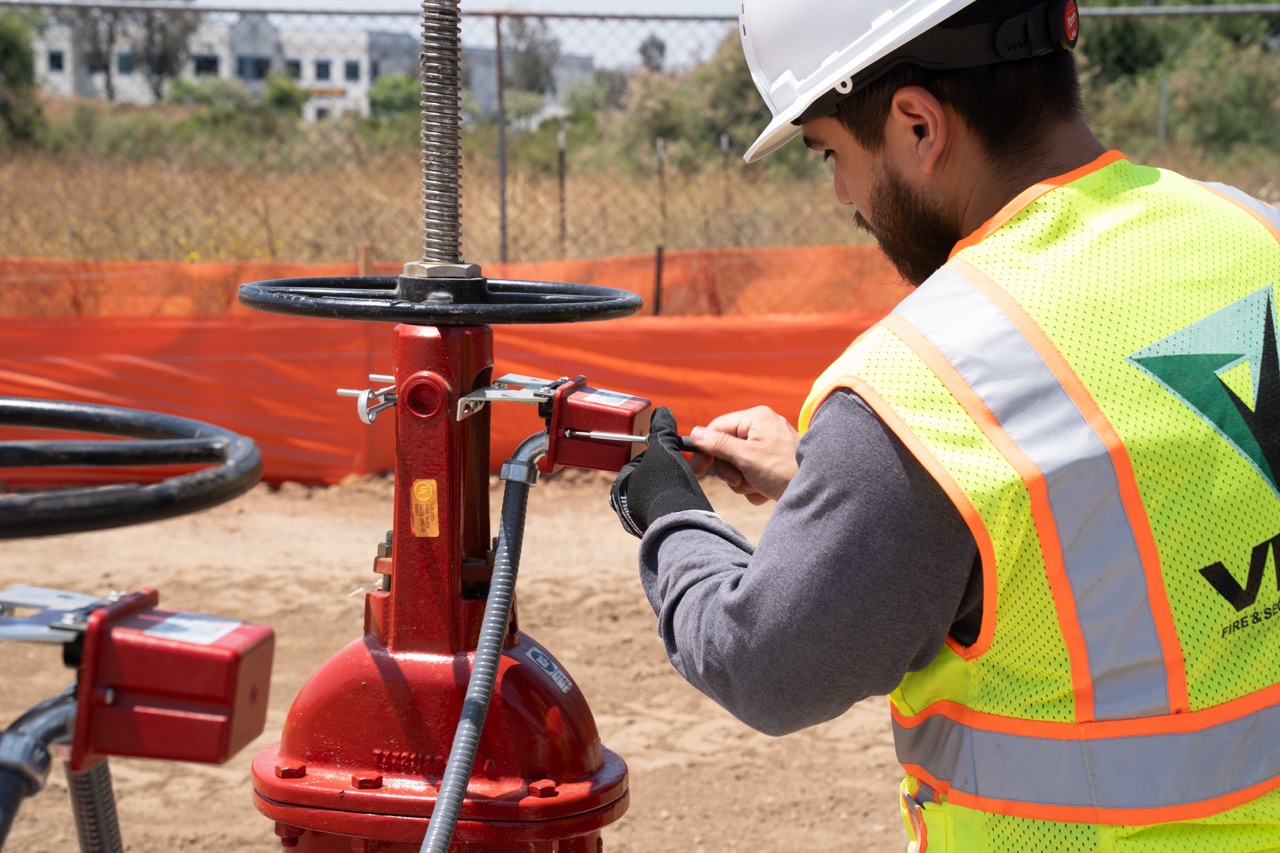
Life Safety Built for the Complexity of Care
From defend-in-place alarm systems and MRI-compatible suppression to infant security and wander management — Fortis provides every life safety discipline healthcare environments demand, under one coordinated service relationship.
Worker in a hard hat and reflective vest inspects a red fire sprinkler valve outdoors.

Fire Suppression Systems

Specialized suppression for MRI and CT suites (where standard suppression agents are incompatible with magnetic field environments), sterile surgical areas, and kitchen operations. Clean agent and CO2 systems that protect critical environments without contaminating clinical spaces.
More about Fire Suppression Systems
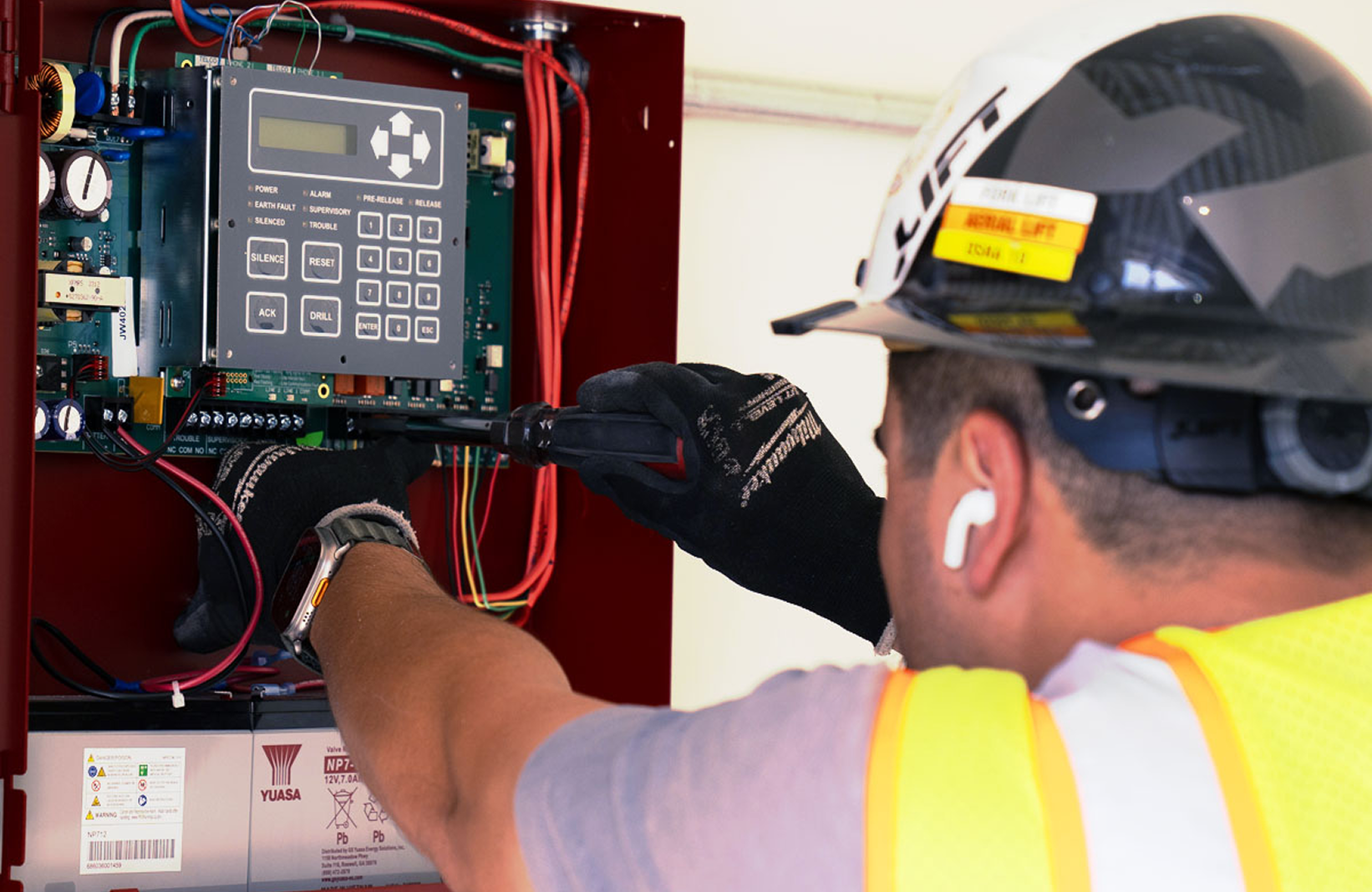
Technician wearing gloves and helmet using screwdriver to work on electrical control panel.

Fire Alarm Systems

Multi-criteria detection that eliminates false alarms without reducing sensitivity to genuine events. Intelligent zoning that supports defend-in-place protocols. Voice evacuation systems for clear, zone-specific direction during emergencies. Full NFPA 72 inspection and testing with Joint Commission-ready documentation.
More about Fire Alarm Systems
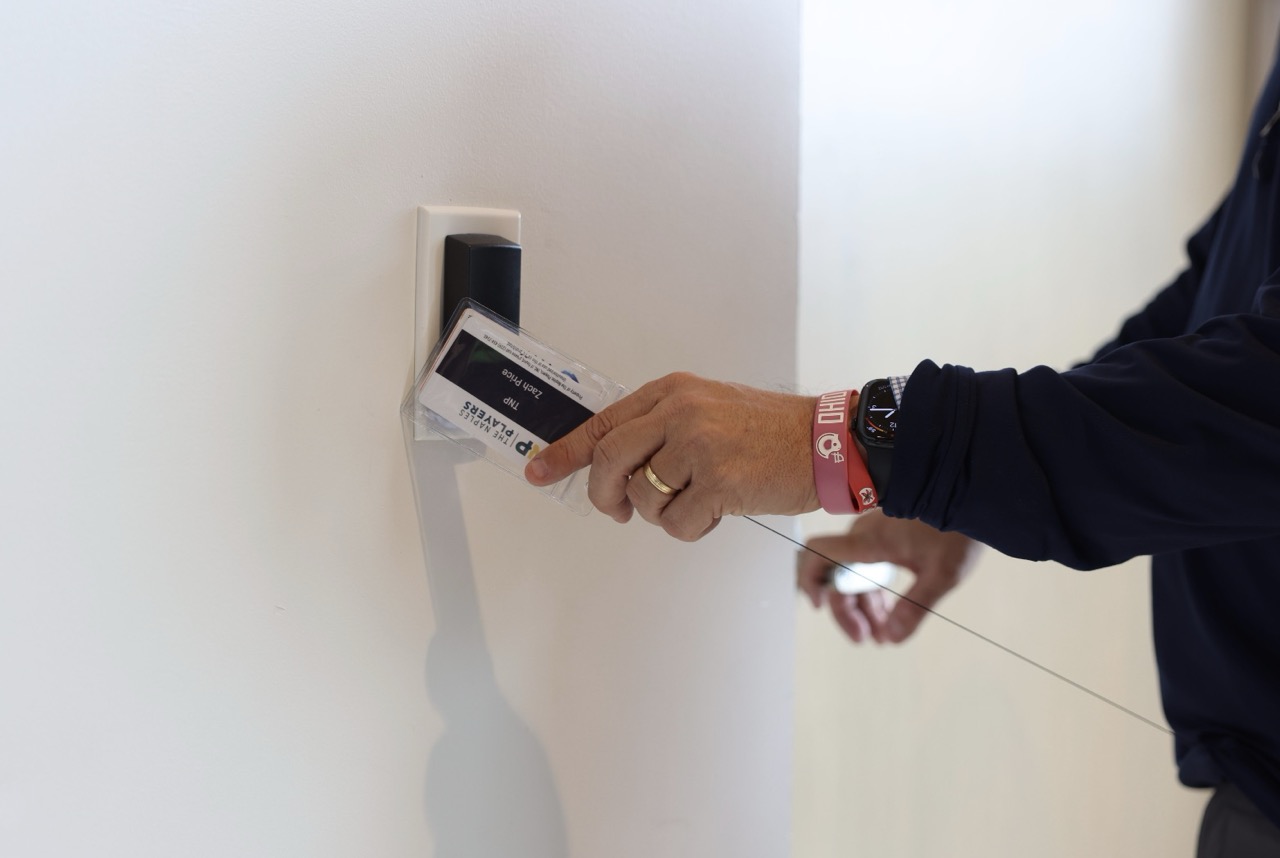
Person holding an ID badge to a wall-mounted card reader for access control.

Security Systems

Infant abduction prevention systems, wander management for memory care residents, access control across clinical and administrative zones, and surveillance coverage that satisfies HIPAA physical safeguard requirements while maintaining complete facility visibility.
More about Security Systems
Close-up of a red fire sprinkler head mounted on a ceiling pipe.

Fire Sprinkler Systems

NFPA 13 and NFPA 25 compliant sprinkler systems designed for the occupancy complexity of healthcare environments — patient rooms, surgical suites, imaging areas, and mechanical spaces all addressed. Inspection programs that satisfy CMS and state health department requirements.
More about Fire Sprinkler Systems
Smiling woman wearing headset, holding and looking at a tablet in an office setting.

24/7 Emergency Service

Around-the-clock emergency response from technicians who understand healthcare environments — the clinical implications of system downtime, the defend-in-place protocols that govern patient safety, and the regulatory notification requirements that apply when systems are impaired.
More about 24/7 Emergency Service

FIRE PROTECTION CODE & COMPLIANCE for healthcare facilities

NFPA. CMS. Joint Commission. AHCA.
The Standards Are Unforgiving. So Are We.
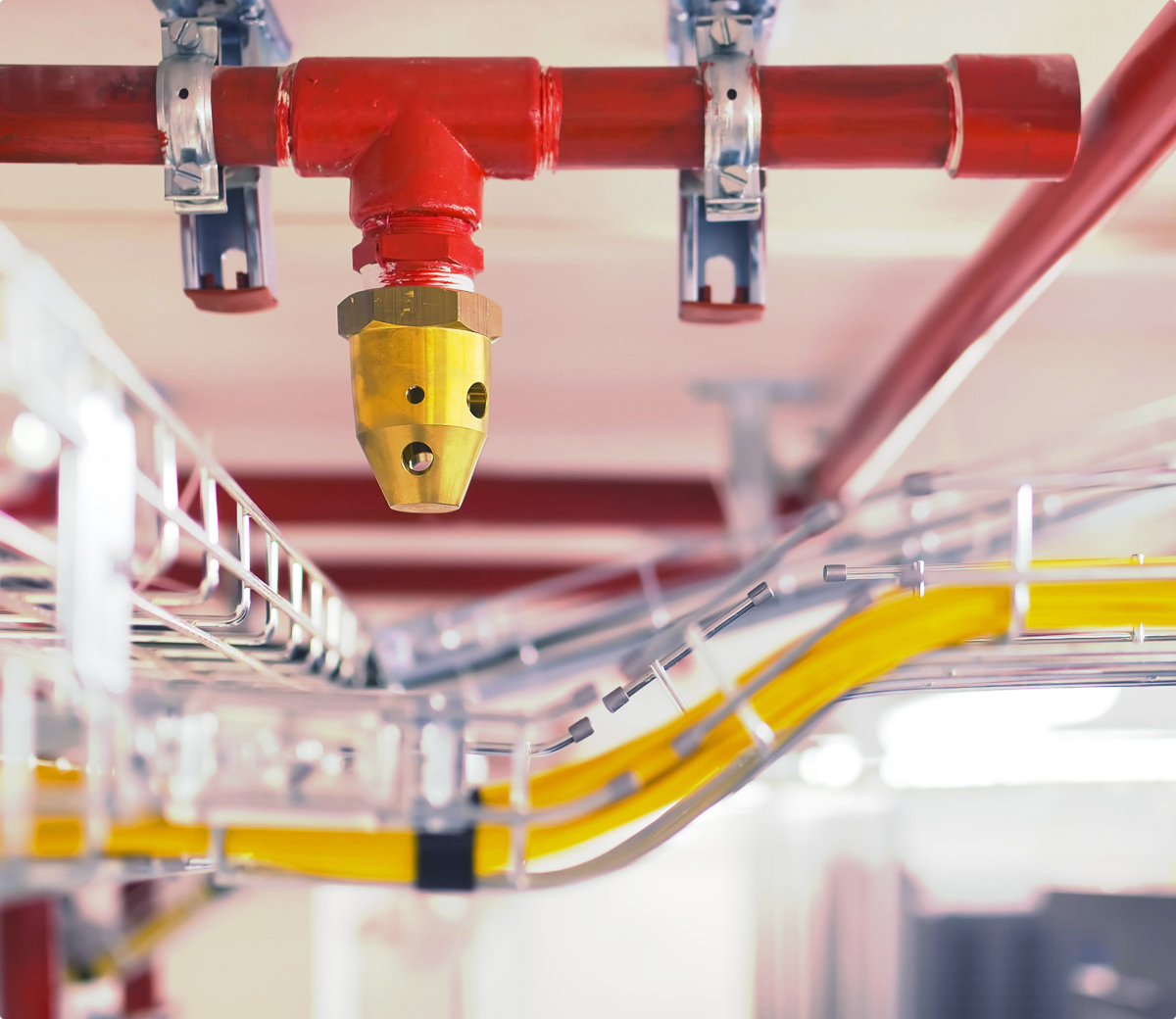
Healthcare facilities face the most layered fire and life safety compliance obligation of any occupancy type — and a deficiency that survives a survey can carry consequences measured in citations, corrective action plans, and reimbursement jeopardy.
Close-up of a red fire sprinkler pipe with a brass sprinkler head attached to ceiling pipes.

NFPA 99

(Health Care Facilities Code) establishes requirements for gas and vacuum systems, electrical systems, and fire protection in healthcare occupancies — with risk category classifications that determine the level of protection required for each area of the facility.

NFPA 101

(Life Safety Code) governs means of egress, fire alarm systems, sprinkler requirements, smoke compartmentation, and defend-in-place protocols for healthcare occupancies. CMS adopts NFPA 101 as the primary life safety standard for Medicare and Medicaid-certified facilities.

CMS Conditions of Participation

require ongoing compliance with NFPA 99 and NFPA 101, with annual fire safety evaluations and documented inspection and maintenance programs. Deficiencies identified in CMS surveys can result in citations, Plans of Correction, and — in severe cases — reimbursement jeopardy.

The Joint Commission

Life Safety chapter requirements mirror CMS standards with additional documentation and survey readiness obligations. Fortis inspection programs produce documentation specifically formatted for TJC survey preparation.
State health department licensure requirements add jurisdiction-specific layers across all markets. Fortis maintains current knowledge of state-level requirements in every region we serve.
Contact Fortis

how it works

here to help, every step of the way
1

Life Safety Compliance Assessment

Fortis begins every healthcare engagement with a comprehensive life safety assessment — evaluating existing system condition, identifying compliance gaps against applicable NFPA, CMS, and state standards, and prioritizing remediation in the context of your survey history and risk profile.
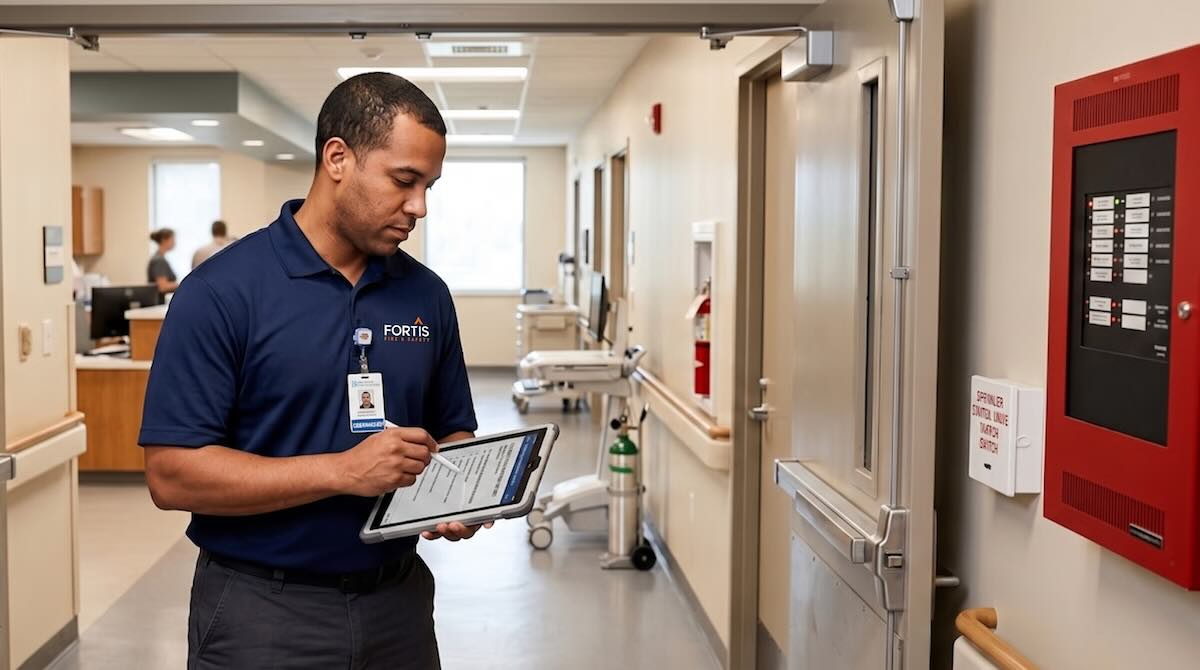
Man in Fortis Fire Safety shirt uses tablet to check life safety compliance in hospital corridor.
2

Coordinated System Design

Fire alarm, sprinkler, suppression, and security systems are designed as an integrated life safety platform — with defend-in-place protocols, smoke compartmentation, and clinical workflow requirements all addressed in the design phase.
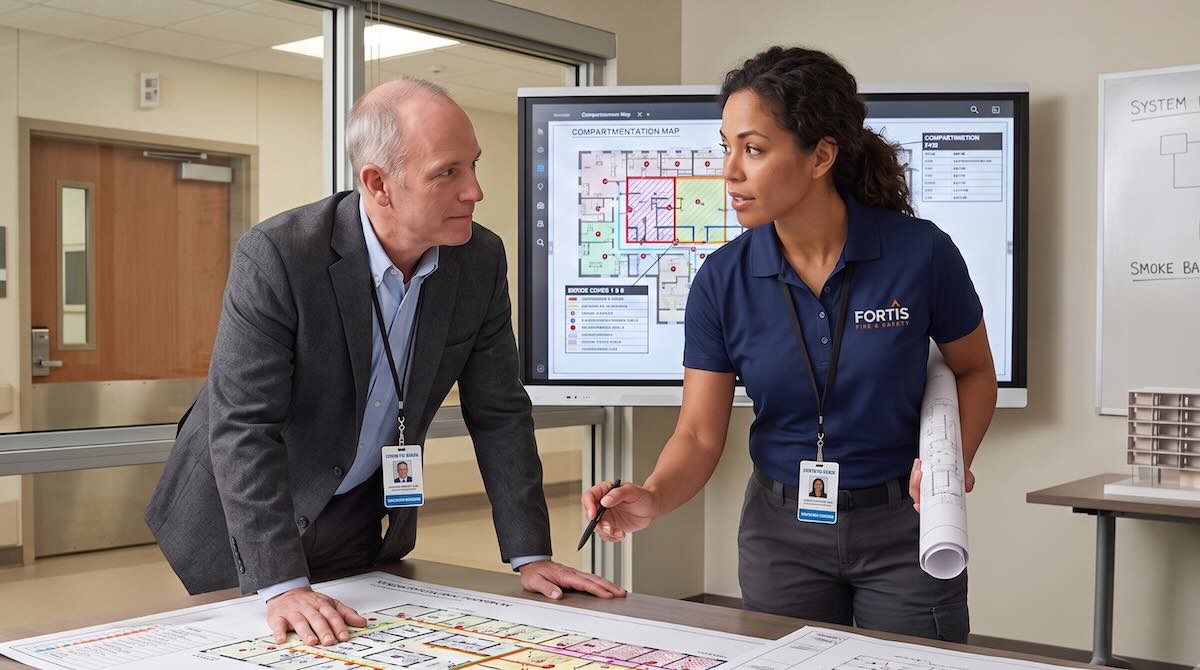
Two professionals discussing building plans with a floor map on table and screen behind them.
3

Clinical-Aware Installation & Maintenance

Fortis schedules installation and maintenance activity to minimize clinical disruption — coordinating with department schedules, infection control requirements, and patient census to deliver protection without interrupting care.
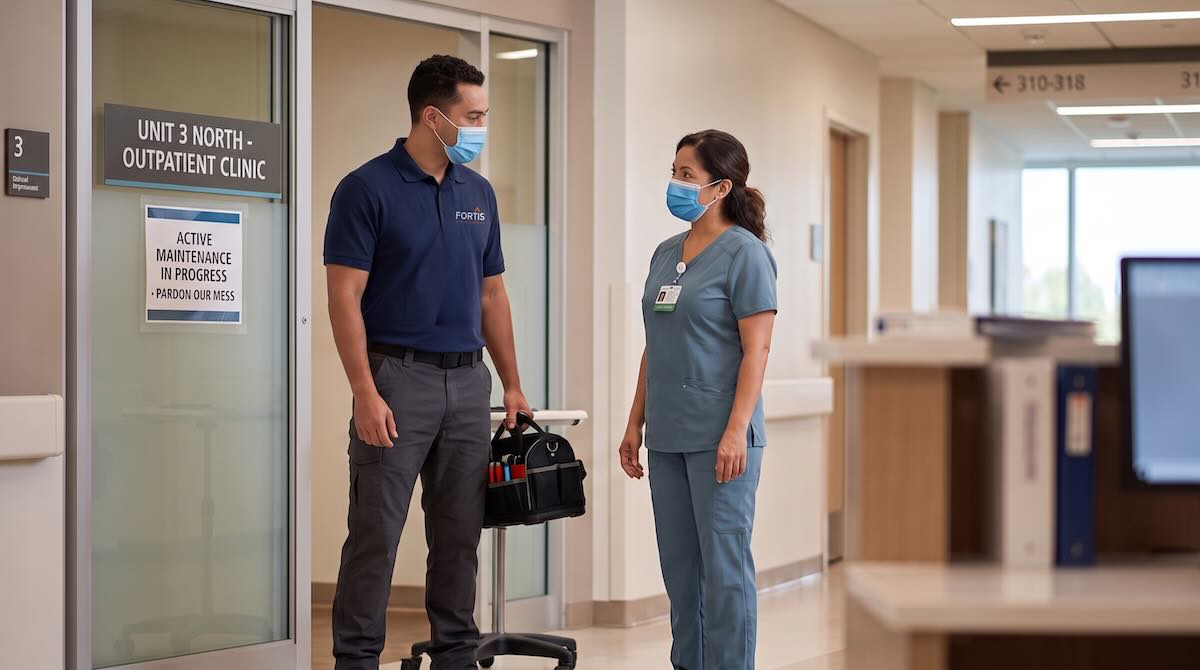
Maintenance worker and nurse wearing masks talking in hospital corridor near outpatient clinic.
4

Survey-Ready Documentation

Every inspection is documented in formats that satisfy CMS, Joint Commission, and state health department requirements. Fortis provides clear deficiency reporting with remediation timelines, giving compliance officers the documentation they need for survey preparation and ongoing regulatory management.
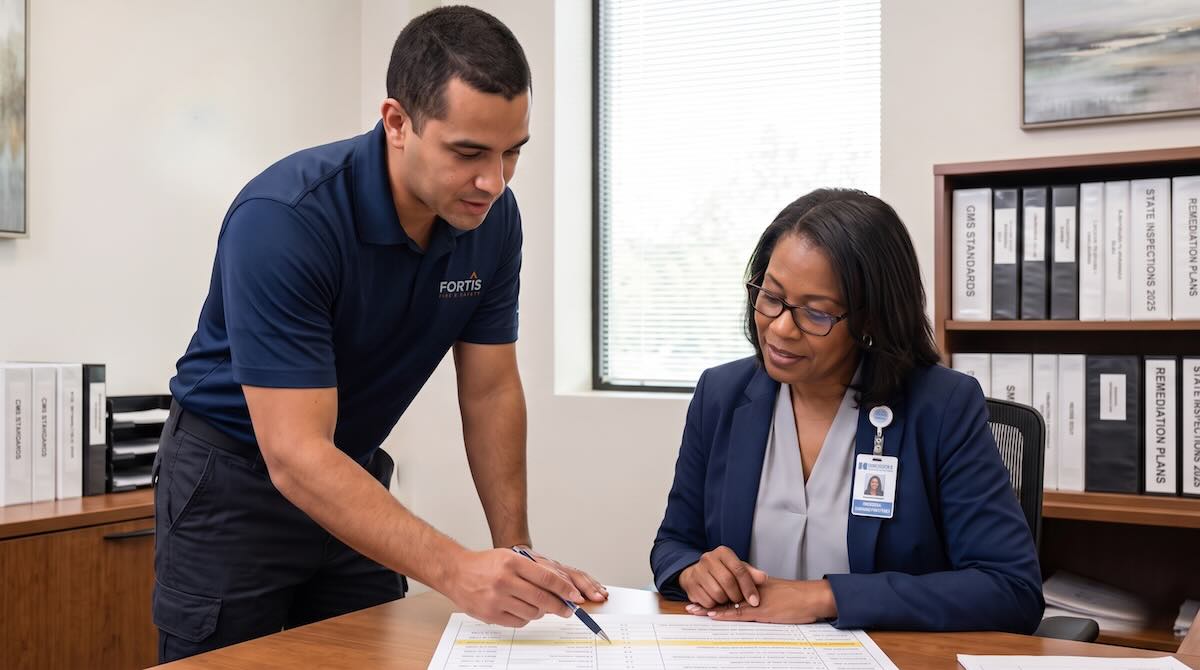
Man in blue Fortis shirt pointing to document while woman in glasses looks on in office.

FREQUENTLY ASKED QUESTIONS

FAQs about fire protection services for healthcare facilities
We get asked a lot of questions about our Fire Protection Services for Healthcare Facilities — here are some of the most common.
What is defend-in-place and how does it affect fire alarm system design?
Defend-in-place is the fire response strategy used in healthcare facilities where patient mobility limitations make full evacuation impractical. Rather than evacuating the entire building, staff move patients horizontally to smoke compartments on the same floor, using the facility's compartmentation to protect them from fire and smoke while emergency services respond. Fire alarm systems in healthcare environments must support defend-in-place protocols through intelligent zoning, staff notification pathways, and smoke door and damper control sequences that isolate the fire compartment without triggering building-wide evacuation.
Why are false alarms particularly dangerous in healthcare settings?
In most commercial facilities, a false alarm is an inconvenience. In healthcare, it is a clinical event. False alarms trigger defend-in-place protocols that require staff to move patients — including those connected to life-sustaining equipment — to alternate compartments. This consumes clinical staff time, exposes patients to movement risk, and in high-frequency false alarm environments, erodes staff responsiveness to genuine events. Fortis designs healthcare alarm systems with multi-criteria detection specifically to eliminate nuisance triggers while maintaining full sensitivity to genuine fire signatures.
What suppression system is appropriate for an MRI suite?
MRI suites present unique suppression challenges because the magnetic field environment is incompatible with most standard suppression equipment and many suppression agents. Water-based systems require non-ferrous components specifically rated for MRI environments. Clean agent systems using FM-200 or Novec 1230 are appropriate where equipment protection is paramount. In all cases, suppression system design for MRI suites requires close coordination with the MRI equipment manufacturer and the AHJ. Fortis engineers have experience designing suppression solutions for imaging environments across all major equipment platforms.
How does Fortis support Joint Commission survey preparation?
Fortis inspection programs produce documentation specifically structured for Joint Commission Life Safety chapter requirements — including element of performance mapping, deficiency tracking with open/closed status, and interim life safety measure documentation where required. Fortis account managers can conduct pre-survey walk-throughs and provide documentation packages in formats aligned with TJC survey preparation workflows.
What wander management systems does Fortis provide for memory care facilities?
Fortis integrates wander management systems that use door alarming, resident monitoring devices, and access control to prevent unsupervised egress by memory care residents — while maintaining the dignity and freedom of movement that quality care requires. Systems are integrated with the facility's fire alarm infrastructure so that fire alarm activations automatically release wander management door locks for emergency egress. Fortis coordinates system selection with facility care philosophy and regulatory requirements for the specific state of operation.

WHY CHOOSE FORTIS for healthcare facilities

The Fortis Difference
Fortis brings clinical-environment expertise, survey-ready documentation, and the kind of scheduling discipline that healthcare compliance officers and facility managers need from a provider — because in healthcare, close enough is never good enough.Data centers demand a level of fire and life safety expertise that general commercial providers cannot reliably deliver. The consequence of a misspecified suppression agent, a missed inspection interval, or a security system that doesn't satisfy a compliance audit is measured in downtime, data loss, and reputational damage that no insurance policy fully covers.

You provide the care. Fortis provides the fortress.
Clinical environment expertise.

Fortis technicians understand the specific demands of healthcare environments — the clinical implications of system downtime, the defend-in-place protocols that govern patient safety, and the regulatory frameworks that determine compliance status. This is not a general commercial service adapted for healthcare. It is specialized expertise built for it.

Survey-ready documentation.

Inspection programs designed to produce documentation that satisfies CMS, Joint Commission, and state health department requirements — giving compliance officers the records they need without the effort of reformatting general inspection reports.

Clinical-aware scheduling.

Maintenance and inspection activity coordinated with clinical schedules, infection control requirements, and patient census — protection delivered without disrupting the care mission it exists to support.

Healthcare Service Area

Fire protection coverage

Fortis Fire & Safety operates through a national network of regionally embedded fire and life safety companies — delivering healthcare life safety expertise in every market we serve, backed by the resources and standards of a premier national organization.

For national account inquiries, contact our National Accounts team.
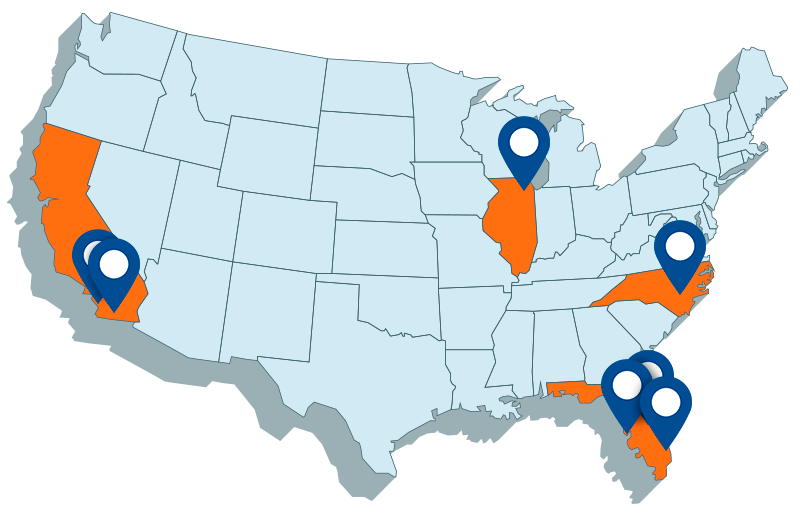
Map of the US highlighting California, Illinois, North Carolina, and Florida with blue location pins.

CJ Suppression

205 Lewis Court
Corona, CA 92882

visit site >

VFS Fire & Security Services

501 W. Southern Avenue
Orange, CA 92865

visit site >

LaMarco Systems

425 Huehl Rd Building 5
Northbrook, IL 60062

visit site >

Diversified Systems, Inc.

1103 Great Falls Court
Knightdale, NC 27545

visit site >

Integrated Fire & Security Systems

1970 Dana Drive
Fort Myers, FL  33907

visit site >

Lifesafety Management

2017 Corporate Drive
Boynton Beach, FL 33426

visit site >

Piper Fire Protection

13075 US Hwy 19 N
Clearwater, FL 33764

visit site >

PROTECT THE MISSION. PROTECT THE PEOPLE.

Talk to a Fortis specialist about Fire & Life Safety for your facility.

Fortis Family of Brands
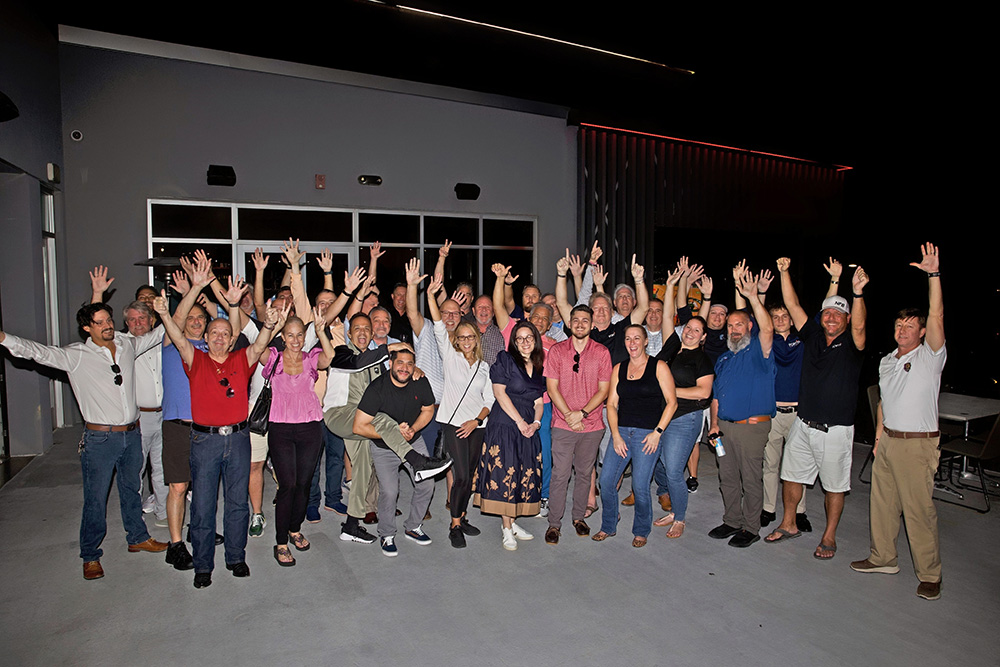
Local expertise, national strength
Large group of people outside at night with raised hands, smiling and posing for a photo.
The best of both — in every market we serve.

Trust is built locally. It lives in the technician who knows your building, knows your local codes, and shows up when something goes wrong at midnight. It lives in the relationship between a fire protection company and the community it has served for decades.


But capability is built at scale. The training standards, the technical resources, the purchasing power, the shared knowledge of a unified national organization — these are the things that make a local provider exceptional rather than merely adequate.

Fortis was built on this belief.

Our network of regionally rooted fire and life safety companies delivers genuine local expertise in every market we serve — technicians who know the regional AHJs, the local codes, and the specific demands of the facilities in their community. Behind each of them stands the full weight of a premier national organization.

You build. You create. You push the world forward.
We protect it all.
CJ Suppression logo with stylized flames above oval containing 'CJS' text, tagged as a Fortis brand.Diversified Systems, Inc. logo with a downward triangle and horizontal line, A Fortis brand.IFSS logo with Integrated Fire and Security Solutions, a Fortis brand text.LSM shield logo with text LifeSafety Management, a Fortis brand on black background.Piper Fire Protection logo with a stylized water droplet and swoosh, labeled a Fortis brand.VFS logo with a triangular symbol above and text Fire & Security Services, A Fortis BrandLAMARCO SYSTEMS logo with text Life Safety & Integrated Security Solutions, a FORTIS brand.